


How to Spot Quality UPVC Formwork — 6 Misconceptions About UPVC Plastic Formwork
If you've been using PVC plastic formworks for a while, you've probably heard the same complaints:
"It warps under the sun."
"It cracks in winter."
"The nails won't hold."
Maybe you've experienced these problems yourself. Maybe you've been told it's normal — that "all PVC formwork does that."
It's not normal.
After 10+ years manufacturing UPVC plastic formwork, I can tell you: those problems don't come from plastic. They come from what some manufacturers put in the plastic.
Here are the six most common misconceptions about UPVC plastic formwork — and the truth behind each one.
Misconception #1: "It's the same as WPC or PVC foam board."
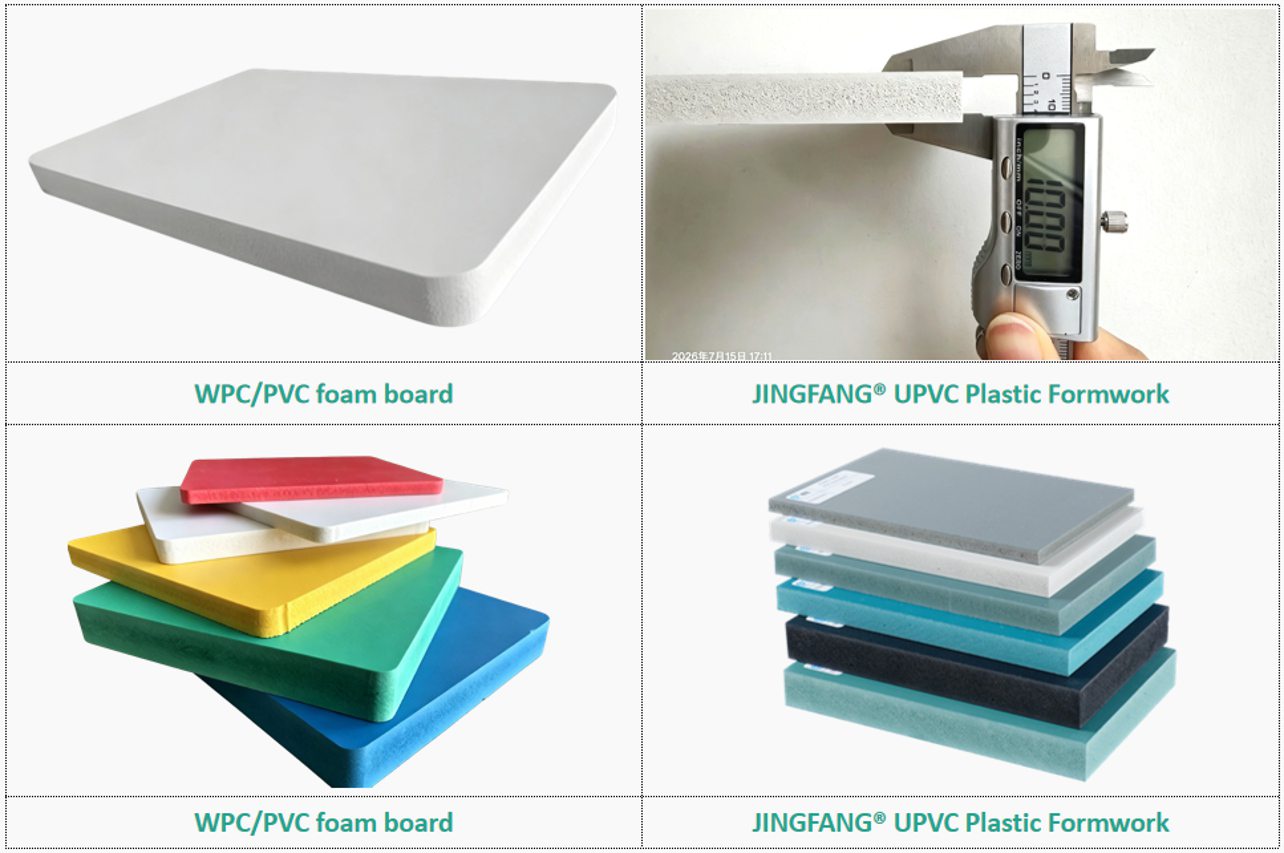
WPC (Wood Plastic Composite) and PVC foam board are made for indoor use — advertising panels, furniture, decorations. They're cheap because they're loaded with 60-80% calcium powder, wood flour, and recycled PVC waste.
JINGFANG® UPVC plastic formwork is different. It's an engineered construction material. The two products are not even manufactured on the same type of machine.
The truth: If a supplier makes both WPC boards and "PVC formwork" on the same production line, their formwork is unqualified. Every field has its master.
Key Items | WPC/PVC Foam Board | JINGFANG® UPVC PlasticFormwork |
Raw Material: | 60–80% calcium powder + wood flour + recycled PVC | 100% Virgin UPVC (>95%) |
Application: | Advertising, furniture, decoration — low strength requirements | Concrete formwork — demands high strength and nail-holding |
Performance: | Low strength, low hardness, poor nail-holding, cracks easily | High strength, excellent nail-holding, 50+ reuses |
Process: | Standard foam board extrusion line | Dedicated formwork production line — cannot be made on WPC machines |
Misconception #2: "If it looks the same color, it's the same quality."
The Hidden Truth — Recycled materials disguised as virgin.
Some suppliers cut costs by using recycled PVC/PP/ABS — costing only 30% or less of our virgin UPVC. These recycled materials come from:
Source of recycled materials | Types of recycled materials |
01. Beverage bottle labels | Recycled PVC |
02. Waste PVC/PP plastic scraps | Recycled mixed plastics |
03. Old temporary rain pipes | Used construction waste |
04. Failed used formwork panels | Reground unqualified products |
💡 Why it matters:
These recycled materials have poor UV resistance and poor weather durabilityEven just 1% contamination causes:
· U-shape or S-shape deformation under sun
· Bending under concrete pressure
· Nail-holding failure
丨Bottom line: If the price difference is huge, the material is different. Virgin UPVC and recycled waste are not the same thing — no matter what color they're dyed.
.jpg "How to Spot Quality UPVC Formwork — 6 Misconceptions About UPVC Plastic Formwork (2)")
Misconception #3: "Deformation is caused by heat, color, or density."
The Lie: Some suppliers claim lighter-colored panels (white, yellow) or higher density prevent warping — because they "absorb less heat" or "are more solid." This is a convenient excuse that blames physics instead of poor material.
The Truth: Deformation is caused by one thing: unqualified raw material. Here's why color and density don't fix it:
· Color can't save bad material. UV radiation penetrates the panel surface regardless of color. A recycled-content panel will break down under sunlight whether it's white, blue, or black.
· Some manufacturers increase density by adding excessive cheap fillers like calcium powder — making the panel heavier, more brittle, and less stable under temperature changes. Others simply cannot control density at all, because recycled material sources are inconsistent and unpredictable.
· Here are the five classic signs, and their true origins:
| Quality Problems | What Really Causes It |
|---|---|
| 01. Deformation & poor UV resistance | Recycled content breaks down under sunlight |
| 02. Poor nail-holding | Excess fillers make the panel brittle |
| 03. Unqualified elastic modulus | Inconsistent recycled materials lack structural integrity |
| 04. Shrinking under UV exposure | Impurities and plasticizers degrade with heat and light |
| 05. Brittleness & easy cracking | Recycled PVC/PP/ABS has already broken molecular chains |
The truth: None of these are "normal." Every single one is a predictable consequence of bad raw material. The fix is not a new formula, or a new color, or higher density, or a "new product" — it's using qualified virgin UPVC from the start.
-1.jpg "How to Spot Quality UPVC Formwork — 6 Misconceptions About UPVC Plastic Formwork (2)")
Misconception #4: "Higher density means better quality."
This one sounds logical. Heavier must be stronger, right?
Wrong. In PVC formwork, higher density almost always means more calcium carbonate filler — a cheap, heavy powder that adds weight but zero strength. A denser panel is often more brittle, cracks more easily around nails, and actually performs worse under stress.
The Wrong Advice: Some suppliers recommend higher density — 750 to 900 kg/m³ — claiming it improves rigidity and prevents warping.
The truth: The industry-proven optimal density for PVC formwork is 700 kg/m³ ±1%. It's the sweet spot between toughness, rigidity, and nail-holding power. Anything much higher than that, and you're paying for filler, not performance.
丨Don't pay for extra filler disguised as quality. 700 kg/m³ is the standard for a reason.
.jpg "How to Spot Quality UPVC Formwork — 6 Misconceptions About UPVC Plastic Formwork (3)")
Misconception #5: "Density tolerance doesn't matter — close enough is fine."
Some suppliers don't bother marking density at all — or they state it with a wide tolerance range like "±5%." What does that mean in real terms?
Here's a simple calculation for a standard 18mm panel (1220×2440mm):
| Specification | Weight | Difference |
|---|---|---|
| 700 kg/m³ (standard) | 37.5 kg | — |
| 750 kg/m³ (unmarked) | 40.2 kg | +2.7 kg |
At a typical price per kilogram, that extra 2.7 kg per panel goes straight into the supplier's pocket — over 7% extra profit — for material you didn't order and don't need. Add in loose thickness tolerance and recycled raw materials, and the hidden profit margins multiply.
The truth: A precise density spec protects you from paying virgin-material prices for fillers and recycled waste. If a supplier can't tell you their exact density tolerance, ask yourself why.
.jpg "How to Spot Quality UPVC Formwork — 6 Misconceptions About UPVC Plastic Formwork (4)")
Misconception #6: "A new, cheaper PVC formwork just launched — it must be a better deal."
The Pattern:
From 2021, the market was flooded with unqualified products. Customers were misled, projects failed, and trust in plastic formwork collapsed. Manufacturers of inferior products lost their reputation — and their orders.
The New Trick:
Unwilling to switch to qualified UPVC (too expensive, too little profit), these same manufacturers now rebrand. They change the color, tweak the appearance, and launch a "new product" — disowning their old failures while attacking proven, qualified formwork like ours. The material inside? Still the same recycled blend.
The Solution:
The answer to deformation is not a new color, a new name, or a new marketing campaign. It's qualified UPVC material, properly manufactured. Everything else is a distraction.
-2.jpg "How to Spot Quality UPVC Formwork — 6 Misconceptions About UPVC Plastic Formwork (2)")
丨UPVC is the industry's well-known, only qualified raw material for PVC formwork. A supplier who argues against it isn't offering innovation, but offering an excuse for never having used this qualified raw material.
The Bottom Line
Bad formwork doesn't announce itself. It looks the same on day one. The problems show up on pour ten, or pour twenty, or the first time the panel sits under direct sun.
But quality leaves evidence. So does poor quality. Ask the professional questions. Ask for the density tolerance. Ask for the SGS test report.
If a supplier can't answer those questions, their "new product" is just old junk in new packaging.
About Linyi Jingfang
Linyi Jingfang Engineering Materials Co., Ltd. is a manufacturer of 100% virgin PVC plastic formwork, H20 timber beams, adjustable steel props, and scaffolding systems.
Since day one, we have been using 100% virgin UPVC as our sole main raw material — comprising over 95% of the formulation. No recycled PVC/PP/ABS. No wood flour. No cheap fillers. This is one of the key reasons why we can strictly control the density tolerance to be within ±1%.
This decision costs more. But it also delivers what no recycled blend can: consistent strength, genuine UV resistance, and 50+ reuses proven on job sites worldwide.
🌐 www.sdjingfang.com
📧 info@sdjingfang.com
📞 +86 178 0611 2299